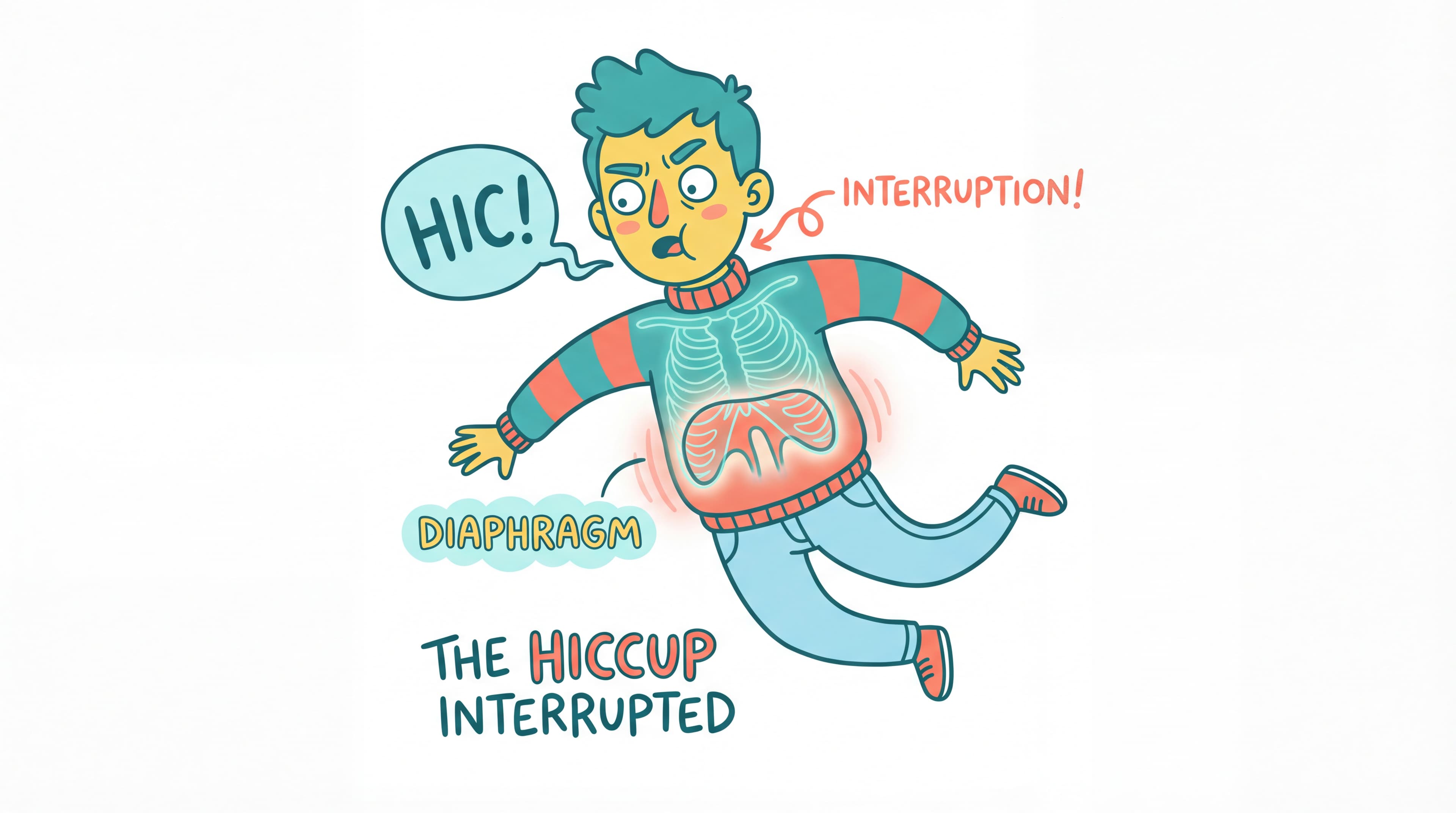

Everyone has a hiccup cure they swear by. Hold your breath. Drink from the far side of a glass. Get someone to scare you. Swallow a spoonful of sugar. Hang upside down while reciting the alphabet backwards (okay, maybe not that one—but some of the real suggestions aren't far off).
Most of these work occasionally, for reasons nobody can fully explain. They're folk remedies dressed up as advice, and when your hiccups happen to stop during one of them, you credit the method and file it away for next time.
There is, however, a technique that targets the actual nerve responsible for hiccups—and it works reliably enough that you might never need a glass of water or a well-timed jump scare again.
What's Actually Happening When You Hiccup
A hiccup is an involuntary spasm of the phrenic nerve, which runs from your cervical spine (around the C3–C5 vertebrae) down to your diaphragm—the main muscle that powers your breathing. When this nerve fires unexpectedly, your diaphragm contracts in a sudden, sharp jolt, sucking air in. A fraction of a second later, your vocal cords snap shut. That's the "hic."
The reason most hiccup cures are unreliable is that they don't specifically address the phrenic nerve. Holding your breath changes your CO2 levels, which sometimes helps. Getting scared jolts your nervous system, which occasionally overrides the spasm. But none of these target the actual circuit that's misfiring.
The Three-Inhale Reset
This technique does. Here's how it works.
Take a big inhale through your nose—fill your lungs as much as you comfortably can. Without exhaling, take a second inhale through your nose, stacking more air on top of what's already in there. You'll feel resistance; that's normal. Then, still without exhaling, take one more tiny sniff through your nose—just a small top-off. Now hold everything for fifteen to twenty seconds. Then exhale slowly through your nose.
The whole thing takes about thirty seconds and looks slightly ridiculous. That's fine. It works.
Why It Works
Those three stacked inhales create an unusually strong, sustained contraction of your diaphragm—much more intense and prolonged than the quick spasms producing the hiccups. This forces the phrenic nerve to fire in a completely different pattern than the spasmodic one driving the hiccup reflex. After this intense, deliberate activation, the nerve essentially resets. Its excitability drops, the spasm loop is interrupted, and the hiccups usually stop.
Think of it like overriding a glitch by flooding the system with a strong, clean signal. The nerve can't maintain its erratic firing pattern while simultaneously handling the sustained load of your maximally inflated lungs.
If the hiccups don't stop after one round, try one more. Most people don't need a third.
Step by Step (For When You're Mid-Hiccup and Impatient)
Don't do this while driving, in water, or standing on anything unstable—you may feel a little lightheaded if you push too hard.
Sit or stand safely. Exhale normally first to clear your lungs. Then: big nasal inhale (fill your lungs), second nasal inhale (stack more air on top—you'll feel the stretch), third tiny nasal sniff (just a little more). Hold for fifteen to twenty seconds. Slow nasal exhale. Wait a moment and see if the hiccups are gone.
That's it. Thirty seconds, no props, no circus tricks.
How It Compares to the Classics
Breathing into a paper bag raises your CO2 levels, which can sometimes influence breathing patterns, but it doesn't directly address the phrenic nerve spasm. It's an indirect approach, and it works inconsistently.
Drinking from the far side of a glass forces you into an awkward position that alters your breathing mechanics. It works sometimes, but it's more of a happy accident than a targeted intervention—and it tends to get water up your nose.
Getting scared delivers a massive nervous system jolt that can occasionally override the hiccup reflex. Emphasis on "occasionally." And it requires a willing accomplice with good timing.
The three-inhale reset is different because it specifically targets the nerve and muscle circuit that's causing the problem. It's simple to reproduce, doesn't need props or friends, and addresses the mechanism rather than hoping for a lucky side effect.
When Hiccups Might Be Something More
Occasional hiccups are completely normal and nothing to worry about. But if you experience hiccups lasting more than forty-eight hours, hiccups that interfere with eating, drinking, or sleeping, or hiccups accompanied by chest pain, severe headache, or other concerning symptoms, see a doctor. Persistent hiccups can, in rare cases, signal underlying conditions that need medical attention.
Bookmark This
Hiccups never show up when it's convenient—they hit during dinner, during a meeting, at 2 AM. So here's the cheat sheet: big nasal inhale, second nasal inhale on top, tiny third sniff, hold fifteen to twenty seconds, slow exhale.
It takes half a minute, it looks a little weird, and it's one of the few hiccup remedies that's actually grounded in nerve and muscle physiology rather than kitchen folklore.
About the Author: Marco Salcedo writes about simple, science-based tools for regulating stress and improving performance. His work focuses on practices you can use in real time, without special equipment.