
At some point, someone has told you to meditate. Probably more than once. And at some other point, someone has told you to "just breathe." Both of these are meant to help with the same thing—stress—but they work in fundamentally different ways, and recent research suggests one of them has a clear edge when you need results fast.
So which one should you actually do? The honest answer is: it depends on what you need and when you need it. But the nuances matter, and most people get them wrong.
How Meditation Works (and What It's Best At)
Meditation—specifically mindfulness meditation—is essentially attention training. You sit still, you bring your focus to your breath or a body sensation, your mind wanders (because that's what minds do), and you gently bring it back. Over and over. The practice isn't the focusing; it's the returning.
Over weeks and months, this builds real, measurable changes: better working memory, improved ability to regulate emotions, greater awareness of your own thought patterns, and yes, reduced stress. Think of it like strength training for your attention—you're not getting stronger during any single rep, but the cumulative effect is significant.
The catch is that meditation is a slow burn. A single five-minute session won't transform your day. The benefits compound with consistent practice, typically ten to thirteen minutes or more per day, sustained over weeks. And there's a practical barrier: when you're acutely stressed—heart pounding, thoughts racing, cortisol surging—sitting quietly and "watching your thoughts" can feel almost impossible. You need a certain baseline of calm just to do the practice that's supposed to make you calm. It's a bit of a chicken-and-egg problem.
How Breathwork Works (and Why It's Faster)
Breathwork takes the opposite approach. Instead of using your mind to influence your body (top-down), you use your body to influence your mind (bottom-up). You change your breathing pattern, and that immediately shifts your heart rate, your CO2 levels, and your neural activity. Your brain doesn't get a vote—it responds to the new physiological signals whether it wants to or not.
This is why breathwork can shift your state in seconds, while meditation often takes minutes or weeks. You're not asking your brain to calm down. You're changing the chemical and mechanical environment your brain is operating in, and it adjusts accordingly.
But not all breathwork is the same. The pattern you choose determines the direction you move.
Box breathing (inhale, hold, exhale, hold—all equal length) is a stabilizer. It balances your nervous system and creates a feeling of centered composure. There's a reason it's the go-to in military and high-stress professions—it doesn't push you toward drowsy or wired, just steady.
Cyclic hyperventilation (deep, repeated inhales and exhales, often followed by a breath hold) does the opposite of calming. It cranks up your autonomic arousal, floods your system with adrenaline, and wakes you up. It's useful as a controlled stress inoculation practice—intentionally spiking your system so you can practice recovering. But if you're already anxious, this is the wrong tool.
Cyclic sighing (repeated physiological sighs—double inhale through the nose, long exhale through the mouth) is where things get interesting. In a recent study that put breathwork techniques head-to-head with meditation, five minutes of cyclic sighing per day produced greater reductions in stress, better mood, and improved sleep than mindfulness meditation, box breathing, or cyclic hyperventilation. It's the closest thing to a "best all-around" breathing practice we have data for.
The Real Difference Between Them
The fundamental distinction isn't about which is "better." It's about direction.
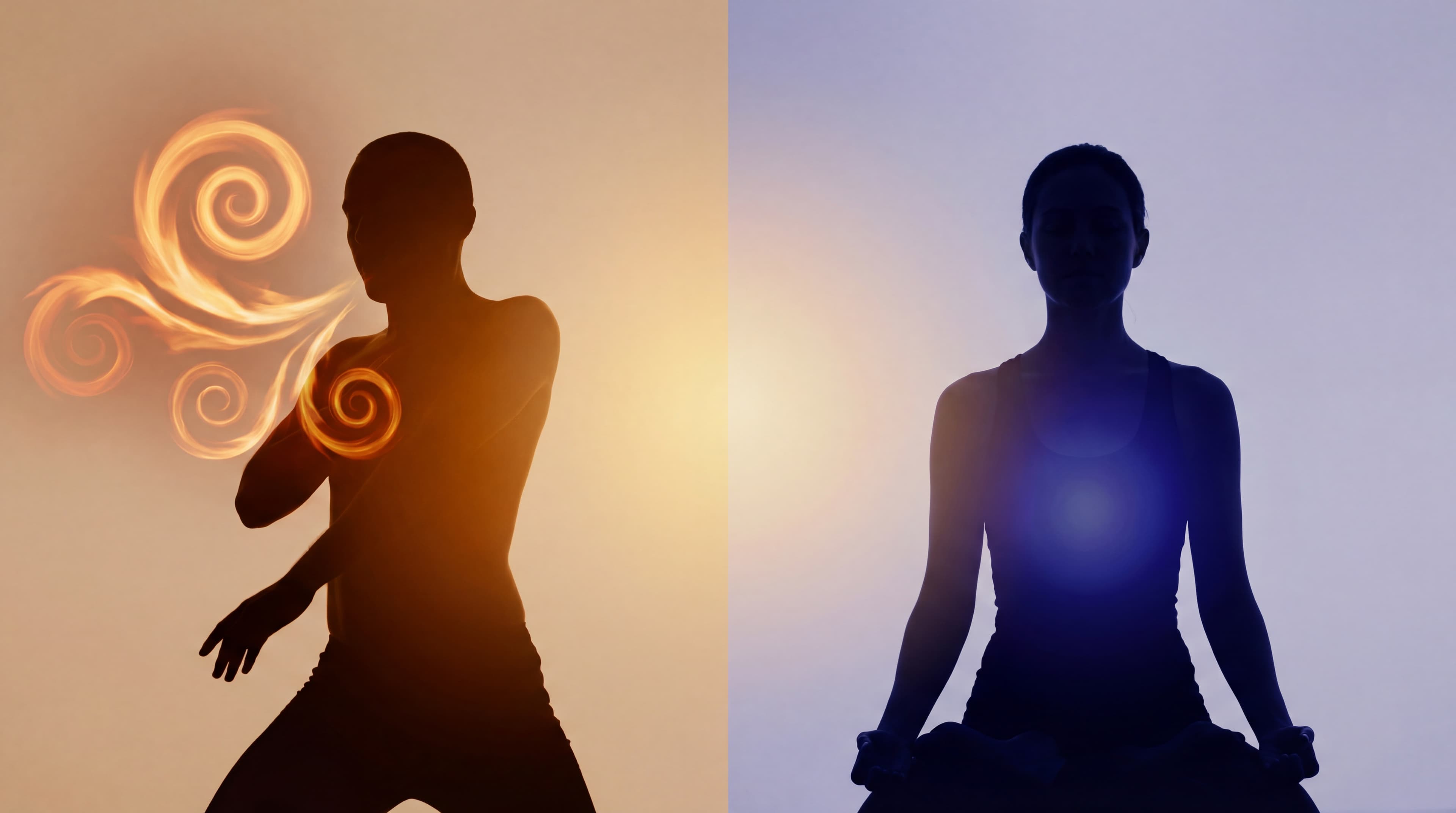
Meditation works top-down: you use your mind to observe and gradually reshape your internal experience. This builds long-term skills—attention, emotional insight, the ability to notice a thought without being hijacked by it. But it takes time, consistency, and a certain amount of mental bandwidth to execute.
Breathwork works bottom-up: you change your physiology, and your mental state follows. This gives you rapid state control—calming, energizing, or stabilizing in the moment—but it doesn't necessarily build the same depth of self-awareness that meditation does.
They're not competitors. They're complementary tools that happen to get lumped together because both involve sitting quietly.
Choosing the Right Tool for the Moment
Reach for breathwork when you're acutely stressed and need a fast downshift, when you can't sleep because your body won't settle, when you're too overwhelmed to focus enough to meditate, or when you only have one to five minutes. The go-to: five minutes of cyclic sighing, once a day.
Reach for meditation when you want to build long-term focus and mental clarity, when you're interested in understanding your own thought and emotional patterns more deeply, when you can commit ten to fifteen minutes consistently, or when you're okay with gradual, compound benefits. The go-to: ten to thirteen minutes of simple breath-focused mindfulness, once a day.
The Hybrid Approach (This Is What I Actually Recommend)
You don't have to pick one. In fact, the most effective approach I've seen is using breathwork as a warm-up to make meditation easier and more effective.
Start with one to three physiological sighs to settle your nervous system. Then meditate for five to ten minutes—focus on your breath or body sensations, return your attention when it wanders. The sighs handle the acute activation so your mind can actually do the work of meditating instead of spending the first five minutes just trying to stop racing.
This way you get the immediate physiological reset from breathwork and the long-term cognitive benefits from meditation. It's the best of both, and the total time commitment is under fifteen minutes.
A Five-Day Experiment to Feel the Difference
If you want to stop debating this in the abstract and actually feel the difference in your own body, try this.
Days one and two, do breathwork only: five minutes of cyclic sighing per day. Just the double inhale through the nose, long exhale through the mouth, repeated for five minutes. Notice how you feel afterward and how the rest of your day goes.
Days three and four, switch to meditation only: ten minutes of basic mindfulness. Sit comfortably, focus on the sensation of breathing, and gently return your attention every time it drifts. Don't judge the wandering—that is the practice.
Day five, combine them: two minutes of cyclic sighing followed by eight minutes of meditation.
Pay attention to which days your stress feels lowest, how easy it is to focus afterward, and how your sleep is each night. Your lived experience will tell you more than any article can.
About the Author: Marco Salcedo writes about simple, science-based tools for regulating stress and improving performance. His work focuses on practices you can use in real time, without special equipment.