
There's a test you can do right now—sitting wherever you are, no equipment, no app—that will tell you something surprisingly useful about your nervous system. It takes about sixty seconds. All you need is a timer and one deep breath.
The test measures your CO2 tolerance: how comfortable your body is with rising carbon dioxide levels. That might sound like an obscure lab metric, but it turns out to be one of the most practical windows into how your body handles stress.
Why This Matters More Than You'd Think
Your urge to breathe isn't driven by running out of oxygen. It's driven by CO2 building up in your blood. When CO2 rises, your brain sends an increasingly urgent signal: breathe now. How quickly that signal turns from a gentle nudge into full-blown panic is your CO2 tolerance—and it varies enormously from person to person.
If your tolerance is low, your nervous system hits the alarm button early. You overbreathe at rest, you feel "on edge" without knowing why, and physical effort feels harder than it should because your body is already convinced it's running out of air. If your tolerance is high, you stay composed longer. You can push deeper into a workout without gasping. You can sit with discomfort—physical or emotional—without your breathing going haywire.
Think of it as the size of your stress buffer. A bigger buffer means more room before your system starts redlining.
How to Take the Test
A quick safety note: don't do this while driving, in water, or standing on anything unstable.
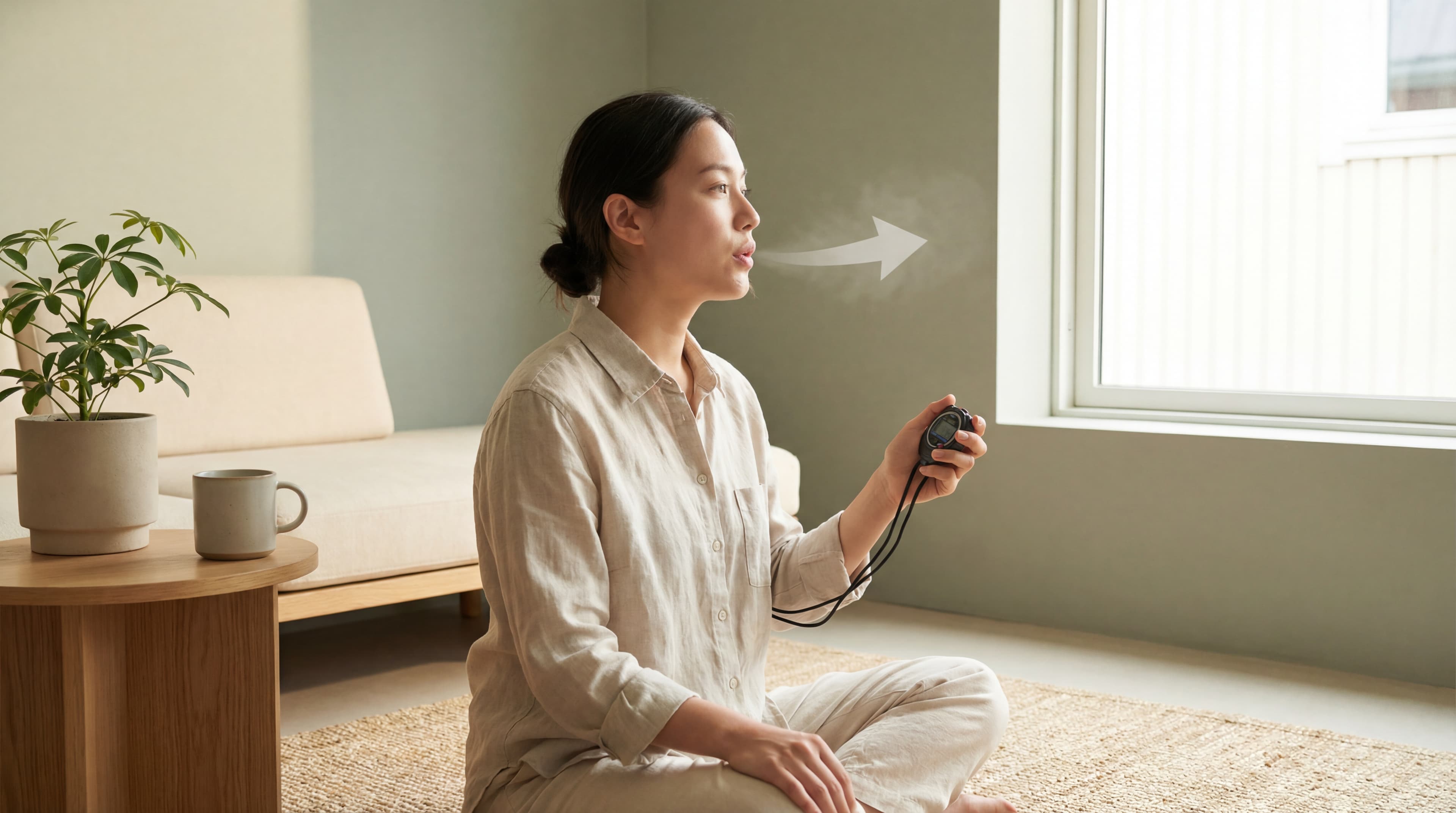
Sit comfortably with your shoulders relaxed. Breathe normally for about thirty seconds to settle in. Then take one full, deep inhale through your nose—fill your lungs using your diaphragm, letting your belly gently expand. Start a timer the moment you begin to exhale, and then exhale as slowly and smoothly as you can through your nose. No pausing, no holding—just one continuous, controlled exhale. Stop the timer when your lungs feel empty and you naturally need to breathe in again.
That's it. One breath, one number.
Important: this isn't a breath-hold test. You're not seeing how long you can sit with empty lungs. You're measuring the length of a single, controlled exhale—how slowly and steadily you can let the air out.
Reading Your Result
Everyone's physiology is a little different, but here's a general framework.
Twenty seconds or less suggests low CO2 tolerance. Your nervous system is probably more reactive than it needs to be, and there's a good chance you're overbreathing during daily life without realizing it. This isn't a diagnosis—it's a starting point.
Twenty-five to forty seconds puts you in moderate territory. You've got a solid foundation and room to improve. Most people who are reasonably active and not chronically stressed land somewhere in this range.
Fifty seconds or more indicates high CO2 tolerance. This is often associated with better endurance, a calmer baseline, and a general ability to stay composed when things get uncomfortable.
Write down your number. You'll use it to calibrate your training.
Training Your CO2 Tolerance with Box Breathing
The beautiful thing about CO2 tolerance is that it's trainable. You're not stuck with whatever number you got. The tool for building it is box breathing: a pattern where you inhale, hold, exhale, and hold again, all for the same duration, forming a "box."
If you scored twenty seconds or less, start with a three-second box. Inhale through your nose for three seconds, hold for three, exhale through your nose for three, hold for three. Repeat for two to three minutes. This will feel manageable but meaningful—you're gently teaching your body that slightly elevated CO2 is safe, not an emergency.
If you scored twenty-five to forty seconds, use a five- or six-second box. Same structure, just slower. This is the range where you'll start to feel a real deepening of calm during the practice.
If you scored fifty seconds or more, try an eight- to ten-second box. At this level, you're refining an already strong system. The holds will feel meditative.
Keep everything smooth and comfortable. If you're gasping or straining at the end of a hold, your count is too high—drop it by a second or two.
What's Actually Changing Under the Hood
With regular practice, three things shift. First, you develop better neuromechanical control of your diaphragm—the muscle learns to contract and relax more precisely instead of firing in the shallow, erratic patterns that characterize chronic overbreathing.
Second, your brain recalibrates its relationship with CO2. Every time you sit calmly while CO2 rises a little, you're showing your nervous system that this isn't dangerous. Over time, the alarm threshold moves. You breathe slower at rest without trying.
Third, your baseline breathing pattern changes. People often notice that their resting breath rate drops naturally—not because they're forcing it, but because their system has genuinely become more efficient.
The payoff shows up in places you might not expect: less background jitteriness, better focus under pressure, more stable energy throughout the day, and for many people, noticeably better sleep.
A Realistic Practice Schedule
You don't need to turn this into a thirty-minute daily ritual. Two to three sessions per week, two to five minutes each, is enough to move the needle.
Weeks one and two: Test your CO2 tolerance on day one, then do two to three short box breathing sessions spaced through the week. Keep the count comfortable.
Weeks three and four: Retest. If your controlled exhale is clearly longer, bump your box count up by one or two seconds. Keep the same rhythm of two to three sessions per week.
That's it. Short, consistent exposure is what reshapes your baseline—not heroic one-off sessions.
What to Watch For
As your CO2 tolerance improves, pay attention to the subtle stuff. Many people report that the background hum of anxiety—that vague sense of being "on edge" that they'd accepted as just how they are—starts to quiet down. Tasks that used to feel overwhelming become easier to sit with. Workouts feel less desperate. Sleep comes a little faster.
You're not forcing yourself to be calm. You're changing the underlying physiology that determines how reactive your system is in the first place. That's a very different thing, and it lasts.
About the Author: Marco Salcedo writes about simple, science-based tools for regulating stress and improving performance. His work focuses on practices you can use in real time, without special equipment.