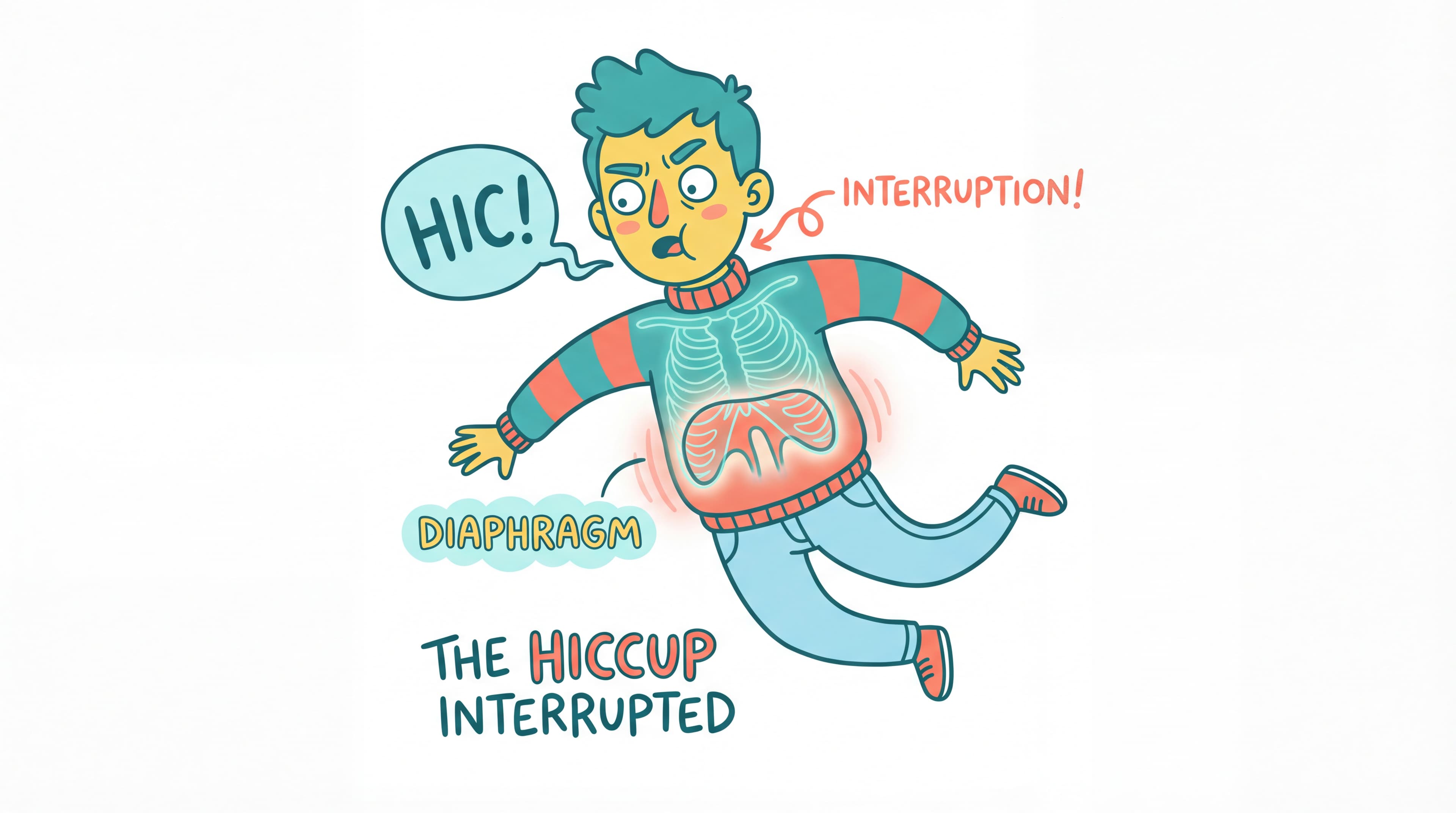

When you hear "hyperventilation," you probably picture someone in a full-blown panic attack, breathing into a paper bag while a concerned friend rubs their back. That's the dramatic version. But there's a quieter kind that's far more common—and you might be doing it right now.
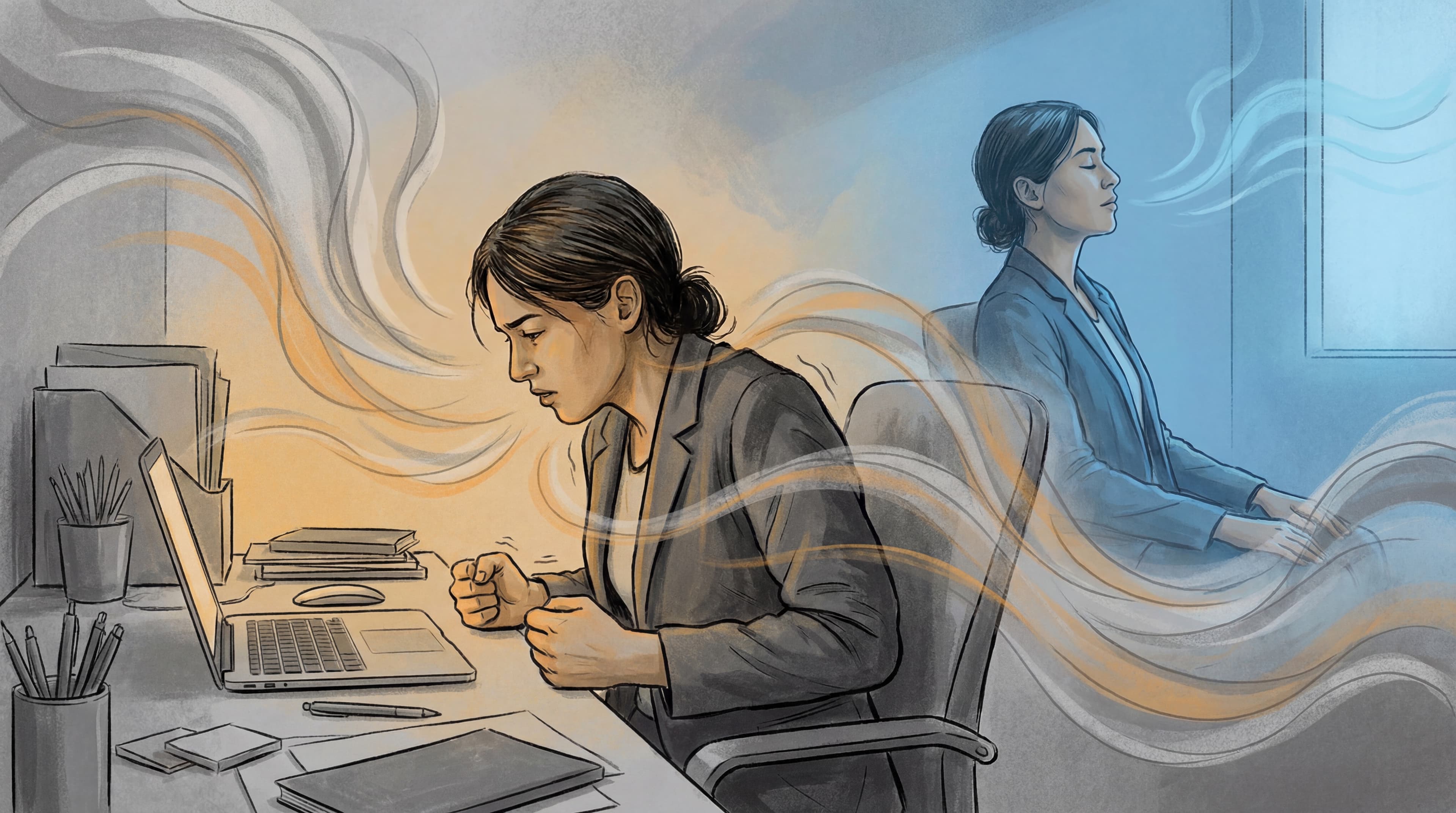
It looks like this: slightly too many breaths per minute, slightly too shallow, all day long. You look perfectly calm on the outside. Maybe you're just sitting at your desk, scrolling through email, sipping coffee. But your nervous system is running a low-grade hyperventilation pattern that's chipping away at your focus, your mood, and your ability to handle stress.
What Overbreathing Actually Means
Overbreathing isn't just breathing fast. It's any breathing pattern where you move more air than your body actually needs at rest—even if each individual breath feels small. The problem isn't the size of any single breath; it's that the cumulative effect blows off more CO2 than your body can afford to lose.
This tends to happen when you're low-key anxious without realizing it (and honestly, who isn't—between email, Slack, news, and whatever your kids are up to). It happens when you sit a lot, slouched forward, breathing shallowly through your mouth. It happens when you're "always a little activated" but never quite stressed enough to notice something is off.
A healthy resting breathing rate for most adults is somewhere around six to ten slow, full breaths per minute. Many people are clocking in at fifteen to twenty-plus without having any idea.
The Domino Effect Inside Your Brain
Here's why those extra breaths matter. Every time you exhale, you release CO2. When you overbreathe, you dump too much of it. And as we covered in the O2/CO2 post, your body needs CO2 to unlock oxygen from hemoglobin and deliver it to your tissues.
When CO2 drops too low, blood vessels constrict—especially in the brain. Less oxygen gets to the neurons that need it most. Your brain doesn't shut down (it's not that dramatic), but it gets noisier. Background neural activity ramps up while the signal-to-noise ratio drops. Laboratory studies show that people with depleted CO2 have a harder time filtering out irrelevant information, maintaining focus, and encoding new memories.
The subjective experience is a feeling you might recognize: wired but foggy. Alert but scattered. You're technically awake and "on," but nothing feels sharp. You can't seem to lock onto one thing without your attention bouncing somewhere else. And there's this vague, hard-to-name unease humming underneath everything.
The Anxiety Loop Nobody Talks About
Overbreathing and anxiety feed each other in a vicious cycle. You feel stressed, so your breathing quickens and shallows—even just slightly. You blow off extra CO2. Your brain becomes more excitable. You feel jittery and uneasy. That unease makes you breathe even faster. More CO2 leaves. The brain gets louder. And around you go.
Most people never identify the breathing as the problem. They think they're anxious because of work, or their relationship, or the news. And those things might genuinely be stressful. But the breathing pattern is amplifying everything, turning a manageable three out of ten into a grinding six out of ten that follows you through the whole day.
Here's how powerful CO2 dynamics are: in controlled experiments, simply shifting someone's CO2 levels can reliably induce panic—even in people whose amygdalae (the brain's fear centers) are damaged. The panic doesn't come from a thought or a memory. It comes from chemistry.
How to Tell If This Is You
You don't need a lab test. There are two simple checks.
Count your resting breaths. Sit quietly for one minute, breathe however feels natural (don't try to fix anything), and count. If you're consistently above twelve breaths per minute at rest, you're probably overbreathing. The key word is "consistently"—one anxious measurement doesn't mean much. Check a few times over a few days.
Notice the pattern. Chronic overbreathers often share certain traits: feeling "on edge" most of the day without a clear reason, being easily startled, frequent unconscious sighing, tightness in the chest or neck or shoulders, and a hard time focusing without constantly checking their phone. None of these on their own is proof, but if several resonate, your breathing is worth investigating.
Three Ways to Start Fixing It
The encouraging news is that your breathing system is remarkably trainable. You're not stuck with the pattern you have.
Switch to nasal breathing by default. Whenever you're not exercising hard, eating, or talking, keep your mouth closed and breathe through your nose. This alone makes a significant difference because your nose adds resistance to airflow, which naturally slows your breathing rate, encourages deeper diaphragmatic movement, and supports nitric oxide production. It's the single lowest-effort change with the highest payoff.
Add tiny pauses between breaths. Overbreathing often means there's zero gap between exhale and the next inhale—it's just a continuous back-and-forth. A few times a day, for one to two minutes, try adding a gentle one- to two-second pause after each exhale before you take the next breath in. Don't force a big hold—just a soft gap. This alone can drop your breathing rate and let CO2 stabilize.
Do two to three minutes of box breathing. Inhale through your nose, hold, exhale through your nose, hold—all for the same count. Use three seconds if you're new or feeling stressed, four to five if you're comfortable. Do it once or twice a day: before work, after lunch, or before bed. It's a structured way to practice slower, more controlled breathing until the pattern starts to become your new default.
The Quick Reset for Bad Moments
When you catch yourself deep in a spiral—doomscrolling, multitasking yourself into oblivion, or just feeling that familiar wired-and-foggy haze—try this sixty-second reset.
Stop what you're doing. Do one or two physiological sighs (double inhale through the nose, long exhale through the mouth). Then spend one minute breathing slowly through your nose: about four seconds in, six seconds out. That's it. You're giving your brain a CO2 reset, lowering your heart rate, and letting the neural "noise" settle so useful signals can stand out again.
It won't fix a bad day. But it will carve out a pocket of clarity, and sometimes that's enough to change the trajectory of the next hour.
Playing the Long Game
Reducing chronic overbreathing isn't about achieving perfect breathing. It's about gradually shifting your default so that your resting breath is slower, quieter, and more diaphragmatic—without you having to think about it.
When that shift happens, you'll notice something subtle but profound: stress still shows up, but your physiology doesn't immediately redline every time. There's more space between the trigger and your reaction. Your brain is quieter at baseline, which means it's sharper when you need it to be. That's not willpower or mindset—it's a real, measurable change in how your nervous system operates. And it starts with paying attention to something you've been doing unconsciously your whole life.
About the Author: Marco Salcedo writes about simple, science-based tools for regulating stress and improving performance. His work focuses on practices you can use in real time, without special equipment.